Outpatient AI at DHITS
Learn how conversational AI, outbound voice outreach, and workflow automation can simplify military medical readiness.
Turning complex readiness processes into guided action
The Outpatient App team is heading to New Orleans for the 2026 Defense Health Information Technology Symposium. Sponsored by the Defense Health Agency, DHITS brings together government, military, and industry health information management and technology professionals to explore new approaches across the Military Health System.
This year’s theme speaks directly to the work Outpatient is advancing: making medical readiness easier to complete, easier to manage, and easier to see.
“Combat Support: Ready, Resilient, Lethal.”
View official DHITS details
Scan to request a demo
AI that helps people complete the mission
Outpatient AI allows service members, providers, and administrators to interact with the system using natural language. A service member can text or speak with the assistant to ask a question, check readiness status, or schedule an appointment without navigating complicated menus or calling a clinic.
The platform also includes an outbound telephony agent that can proactively contact service members, guide them through next steps, and support readiness outreach at scale as part of the same coordinated Outpatient workflow.
Conversational Assistance
Use text or voice to get answers, understand what is due, and take action.
Outbound Voice Outreach
An AI telephony agent can proactively reach service members and guide readiness follow up.
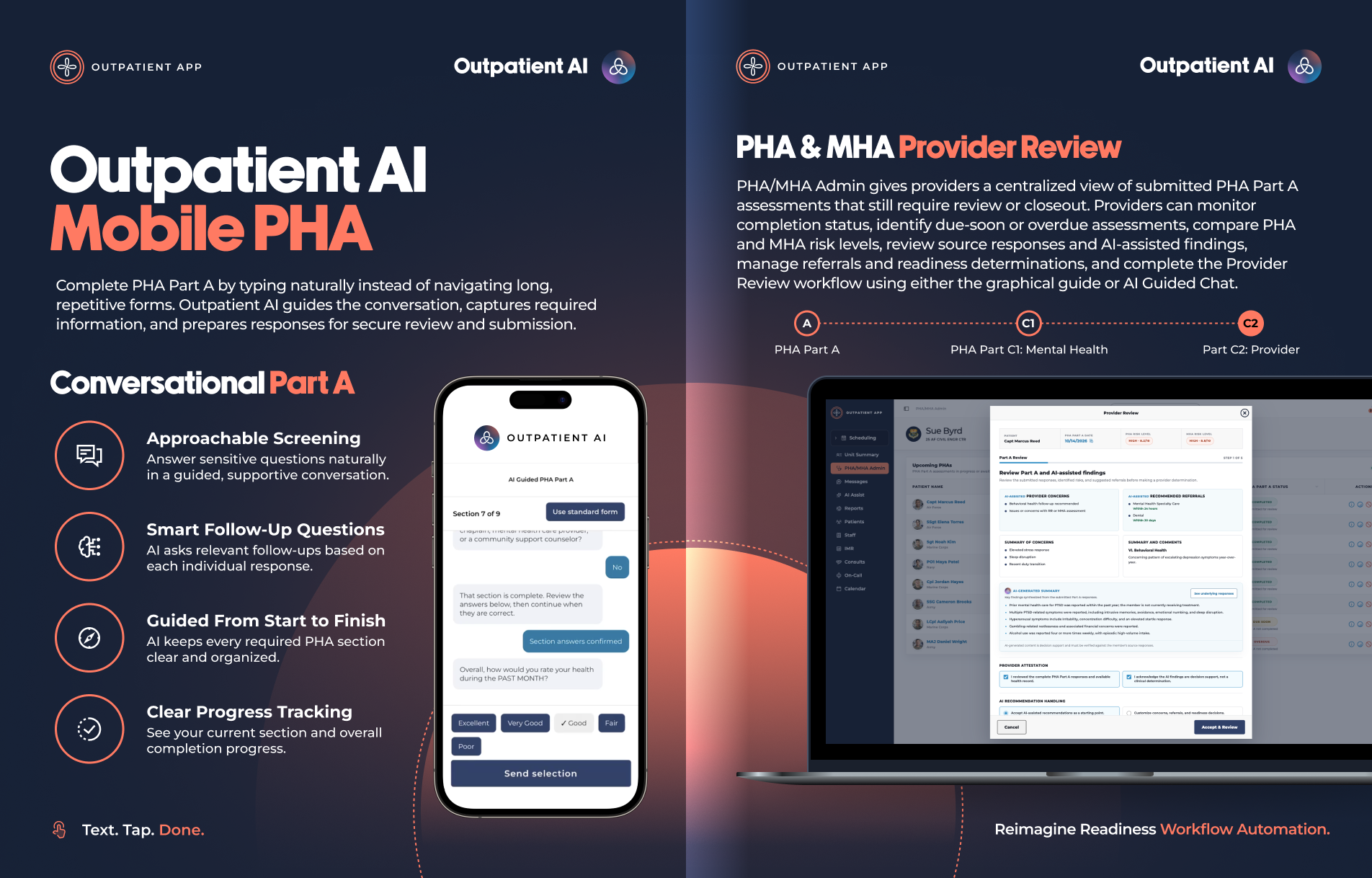
Mobile PHA Completion
A guided conversation simplifies PHA Part A, asks smart follow up questions, and shows clear progress.
Readiness Self Scheduling
Automated workflows support PHA, labs, immunizations, DRHA, dental, audiograms, CMR, and more.
Provider and Admin Review
Review PHA and MHA responses, monitor due items, manage referrals, and complete determinations.
Operational Visibility
IMR, Dental Readiness, Warrior Messaging, and reporting provide a clearer readiness picture.
A more direct path to completed readiness
Readiness delays often begin with small points of friction. A missed call, an unclear next step, a full voicemail box, or a scheduling request passed between multiple teams can slow the entire process.
Outpatient connects these steps in one experience. A service member can receive a secure message, understand the requirement, find an available provider, request an appointment, and receive confirmation from a mobile device. Staff can monitor progress and exceptions without relying on disconnected spreadsheets, inboxes, and manual follow up.
The result is less administrative work for medical teams and better readiness visibility for leadership.
Authorized for the mission. Structured for acquisition.
Innovative technology only creates value when it can operate securely inside the mission environment and move through a practical acquisition path.
Authority to Operate
Authorization first, ready for the mission
- ATO delivery model within the DAF Cloud One enterprise hosting environment
- Authorized within the Department of War environment at Impact Level 5
- Compliance reciprocity across other federal agencies
- FedRAMP High controls with continuous security and compliance monitoring
Live SBIR Phase III IDIQ
Supporting Air Force Medical and DoW broadly
- Sole source acquisition path for eligible federal customers
- Applicable competition requirements satisfied
- Flexible contract ceiling and duration
- A practical path from evaluation to operational deployment
Together, the Authority to Operate, compliance reciprocity, and contract vehicles make Outpatient more than a promising technology solution. They provide a realistic path to operational use.
See readiness automation working as one secure experience
Meet the Outpatient team in New Orleans to see conversational AI, outbound telephony, mobile PHA, readiness scheduling, provider review, and operational dashboards working together.
Text. Tap. Done.Readiness, in motion.